

By
Karis Simms
If your audiogram shows severe or profound hearing loss, you'll already know that not every hearing aid is going to cut it. Standard everyday devices are built for mild to moderate loss, and they simply don't have the power, feedback control, or battery capacity to work at this level.
In this guide, we'll walk through what actually makes a hearing aid suitable for severe hearing loss, compare the leading power models we stock, and help you work out which one fits your life, all in plain English, with no medical jargon required.
What Counts as Severe Hearing Loss?
Hearing loss is measured in decibels (dB HL), the quietest sound you can just about hear. Here's how the categories break down:
|
Hearing Threshold |
Degree of Hearing Loss |
What It Can Sound Like |
|
26 to 40 dB |
Mild hearing loss |
Difficulty with soft sounds or quiet speech |
|
41 to 55 dB |
Moderate hearing loss |
Struggling with normal conversation, especially in background noise |
|
56 to 70 dB |
Moderately severe hearing loss |
Needing raised voices to follow conversation |
|
71 to 90 dB |
Severe hearing loss |
Trouble hearing loud speech and most everyday sounds |
|
91 dB and above |
Profound hearing loss |
Little to no hearing without amplification |
At the severe end, everyday sounds, a raised voice, traffic, a doorbell, become very hard to hear without significant amplification. Because accurate amplification at this level depends on precise measurements across every frequency, you'll need a full hearing test or audiogram completed in person, by your GP, an NHS audiologist or a private clinic, before a power hearing aid can be selected and programmed for you. Our guide on how to read your audiogram explains what those numbers actually mean once you have them.
What Makes a Hearing Aid Suitable for Severe Hearing Loss?
Before we get into specific models, here's what separates a genuine power hearing aid from a standard one.
Maximum Power Output (MPO). This is the ceiling on how loud a hearing aid can go before it distorts. Severe and profound loss needs a high MPO, a standard receiver-in-canal (RIC) device will simply max out and start to sound harsh or feedback-prone long before it's loud enough to help.
Feedback cancellation. More gain means more risk of whistling. The better power hearing aids use advanced digital feedback suppression so you can run higher volumes without that squeal.
Form factor. Behind-the-ear (BTE) hearing aids are the standard choice for severe to profound loss, since the larger casing allows for a bigger receiver, more powerful battery, and usually a custom earmould that seals more effectively than an open dome. Our guide on RIC vs BTE hearing aids goes into more detail if you want the full comparison.
Battery type and life. Power hearing aids draw more energy, so battery capacity matters more here than with a standard device. Some power BTEs still use disposable zinc-air batteries for maximum runtime, though rechargeable super power models are now catching up.
Directional microphones and noise handling. Severe hearing loss makes it much harder to naturally tune out background noise, so strong directional microphones and noise reduction do more of the heavy lifting.
Quick tip: If you already wear a RIC hearing aid and find yourself turning the volume up to maximum in most situations, that's often a sign it's time to talk to an audiologist about a power BTE instead.
The Best Hearing Aids for Severe Hearing Loss
Phonak Infinio Sphere i90 - Our Top Pick for Speech Clarity in Severe Hearing Loss
The Phonak Infinio Sphere i90 is Phonak's flagship model, and it's our most recommended hearing aid overall. It's the world's first hearing aid with a dedicated AI chip (DEEPSONIC), built specifically to separate speech from background noise, and it's engineered to help significantly with the listening effort that comes with moderate-to-severe hearing loss, not just the volume of sound.
A few reasons it's our hero pick:
-
Best-in-class speech-in-noise performance. A 10 dB signal-to-noise ratio improvement means conversations in restaurants, group settings and busy environments are dramatically easier to follow, often the single biggest frustration for people with severe hearing loss.
-
Advanced waterproofing and all-day battery. Up to 56 hours on a single charge without streaming, and around 16 hours with continuous Bluetooth use.
-
Full smart connectivity. Bluetooth 5.3, hands-free calling, Auracast-ready, and works with Phonak's Roger remote microphone range for extra reach in the toughest listening situations.
Where it fits: the Infinio Sphere i90 is a premium receiver-in-canal (RIC) device, so it's best suited to severe hearing loss rather than the very top of the profound range. If your loss sits at the more advanced end of severe, or profound, a power BTE like the Naída below will typically deliver more usable amplification. Our audiologists can confirm which is right for your specific audiogram before you buy.
Phonak Naída - Best for the Highest Levels of Severe to Profound Loss
Where the Infinio Sphere reaches its limit, the Phonak Naída picks up. It's Phonak's dedicated power range, built specifically for severe and profound hearing loss rather than adapted from a standard model. It's a BTE design, available across three technology tiers:
|
Model |
Price From |
Best For |
|
£765 |
Essential power on a lower budget |
|
|
£865 |
A step up in noisy environment handling |
|
|
£1,010 |
The smoothest automatic adjustment in complex, noisy situations |
All three sit on Phonak's Lumity platform and share the same core power and connectivity: direct streaming to iOS and Android, hands-free calling, myPhonak app control, and an IP68 water and dust resistance rating. The difference between the tiers comes down to how well the automatic sound processing adapts across different listening environments.
ReSound Enzo IA - One of the Very Best for Severe to Profound Loss
The ReSound Enzo IA is one of our favourites in this category, and for good reason. It's the world's smallest rechargeable Super Power hearing aid, built specifically for severe to profound hearing loss, without the bulk that traditionally comes with that level of amplification.
What makes the Enzo IA stand out:
-
Intelligence Augmented (IA) processing. A dedicated 360 chip uses machine learning to read your environment in real time and adjust automatically, rather than simply pushing more volume at every situation.
-
Clear Focus beamforming. One of the most precise directional systems available, designed to spotlight speech directly in front of you while dialling down distractions from other directions, genuinely useful in restaurants, cafés and other noisy venues.
-
Best-in-class feedback management, so you can run higher amplification levels with far less whistling or squealing.
-
28 hours of battery life in a rechargeable Super Power design, plus Auracast and Bluetooth LE Audio support for streaming at home and in public venues.
Best for: severe to profound loss where you want serious amplification and strong feedback control in a genuinely compact, rechargeable design.
Signia Motion Charge & Go SP 7X - Best Rechargeable Super Power Option
The Signia Motion Charge & Go SP 7X is worth knowing about if you specifically want to avoid disposable batteries. It's marketed as the world's first rechargeable Super Power BTE, built on Signia's Xperience platform with acoustic-motion sensors, Bluetooth connectivity, and telecoil.
Signia Motion 13 / 13P - A Lower-Cost BTE Option
Signia's Motion Nx range also includes the Motion 13 and the more powerful Motion 13P, both BTE models designed to cover mild through to severe/profound loss with a telecoil-compatible battery door. These sit at a more accessible price point than the SP 7X if rechargeability isn't a priority for you.
Do You Need a BTE, or Could a RIC Work?
Most people with severe hearing loss are best suited to a BTE, but it isn't an absolute rule. Some of the newest premium RIC devices, like the Phonak Infinio Sphere i90 or the Phonak Audeo Lumity L90, now reach further up the power range than RICs used to, and some people prefer the smaller, more discreet shape if their loss sits at the lower end of severe rather than deep into profound.
The right call depends on your specific audiogram shape, your ear canal, and how much amplification you actually need, which is exactly what our remote fitting service is there to work out with you.
How Much Do Power Hearing Aids Cost?
Across our range, hearing aids suited to severe hearing loss typically start from around £765 for a power BTE and rise to £1,250+ for a premium AI-driven model like the Infinio Sphere i90. You're not necessarily paying more just because you need more power, in many cases you're paying for the technology tier and features you choose, such as AI noise separation, rather than raw amplification alone. Our full pricing guide breaks down what drives cost up or down across the board.
What Should I Do Next?
Once you know your hearing falls into the severe or profound range, here's what typically comes next:
-
Get a hearing test or audiogram done in person. This needs to be carried out by your GP, an NHS audiologist or a private clinic, we need the full picture across all frequencies before we can select or programme a power device.
-
Send us the results. Once you have your hearing test or audiogram, send it over and we'll talk you through your options, answer any questions, and confirm the right technology tier for your loss.
-
Get matched to a technology tier. Severe and profound loss narrows the field to power and super power BTEs, from there it's about how much automatic noise handling and connectivity you want.
-
Have your hearing aids programmed remotely. Every pair we send out is programmed to your results by UK-qualified audiologists before it arrives, with remote fine-tuning available afterwards if anything needs adjusting.
-
Ask us directly if you're unsure. You can speak to one of our audiologists before you buy, there's no obligation, and it's often the fastest way to rule options in or out.
If you're not sure where to start at all, our guide to choosing the right hearing aid covers the basics for every level of hearing loss, not just severe.
Not sure which power hearing aid is right for you?
Because severe and profound hearing loss needs to be mapped accurately across every frequency, we can only select, programme and dispatch a power hearing aid once we have a full hearing test or audiogram completed in person, by your GP, an NHS audiologist or a private clinic. Once you have that, send it to us and one of our UK-qualified audiologists will talk you through your options, answer any questions, and get your hearing aids programmed to your results before dispatch.
Send Us Your Hearing Test Results Speak To An Audiologist
Frequently Asked Questions
What is the best hearing aid for severe hearing loss?
Our top recommendation is the Phonak Infinio Sphere i90, thanks to its AI-driven speech-in-noise performance, which is often the biggest day-to-day challenge with severe hearing loss. For the highest levels of severe to profound loss, the Phonak Naída L90, ReSound Enzo IA and Signia Motion Charge & Go SP 7X all offer excellent raw power as purpose-built BTE devices, each with a slightly different balance of processing technology, battery type and design.
Can a hearing aid fully restore my hearing if I have severe hearing loss?
No hearing aid fully restores natural hearing. A well-fitted power hearing aid can dramatically improve speech understanding and everyday sound awareness, but some limitations remain at this level of loss, which is why accurate programming matters so much.
Is a BTE hearing aid better than a RIC for severe hearing loss?
Generally yes, because BTE devices have more room for a powerful receiver and battery. Some newer premium RIC models are closing that gap, but BTE remains the more reliable choice for severe to profound loss.
How long does it take to adjust to a new power hearing aid?
Most people need two to four weeks of consistent daily wear to adjust, with full adaptation taking up to around three months as your brain relearns to process amplified sound.
Do I need to see an audiologist in person to get a power hearing aid?
You don't need to visit us in person, we programme remotely once you send us your results, with further remote adjustments available afterwards. However, the hearing test or audiogram itself does need to be carried out in person, by your GP, an NHS audiologist or a private clinic, since accurate programming for severe or profound loss depends on precise, professionally measured results. See our how it works page for the full process.
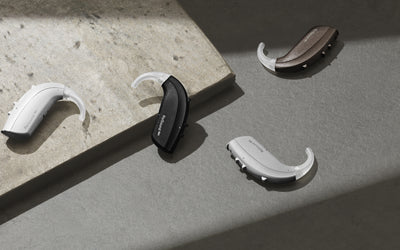
Shop All Hearing Aids
Shop now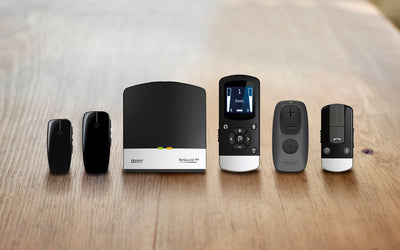
Shop Accessories
Shop now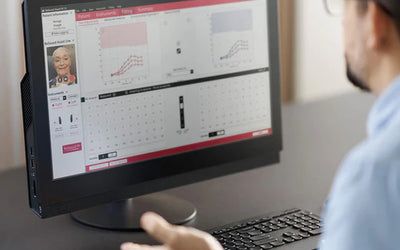
Speak To Our Audiologists
Contact Us