

By
Karis Simms
"AI" gets attached to almost everything these days, and hearing aids are no exception. But underneath the marketing language, there's a genuinely useful piece of technology worth understanding, especially if you're trying to work out whether it's worth paying attention to, or just another buzzword. Here's what an AI hearing aid actually does, in plain English.
What makes a hearing aid "AI-powered"?
Every modern digital hearing aid already does some clever processing, amplifying sound, filtering out some background noise, and automatically switching between listening programs as your environment changes. What separates an AI hearing aid from a standard digital one is how that processing happens.
Standard hearing aids use fixed rules: if the background gets loud, reduce gain in certain frequencies; if speech is detected from the front, prioritise it. These rules work reasonably well, but they're one-size-fits-all, and they start to struggle in genuinely chaotic sound, a busy restaurant, several people talking at once, music playing in the background.
AI hearing aids take a different approach. Rather than following fixed rules, they use a deep neural network, a type of processing trained on millions of real-world sound samples to recognise the difference between speech and noise, then reconstruct the voices you want to hear in real time. It's less "apply a filter" and more "actively rebuild the sound around you," which is why the difference can be so noticeable in loud, unpredictable places.
Why this needs its own dedicated chip
Running that kind of processing in real time takes a lot of computing power, far more than a standard hearing aid chip has spare, once it's already handling amplification, Bluetooth, and automatic program switching. This is the main reason true AI processing has only recently become possible inside a device small enough to sit behind your ear.
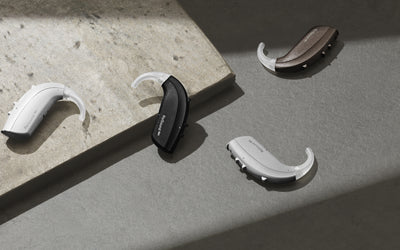
The clearest example of this on the market right now is the Phonak Infinio Sphere, which uses a second, dedicated processor (called DEEPSONIC) purely for this job, running alongside its main chip. Because the AI processing isn't competing for resources with everything else the device is doing, it can run far more intensively than it could on a single chip.
What difference does it actually make day to day?
The honest answer: for quiet, predictable environments, not a huge amount, a good standard hearing aid already handles those well. Where AI processing tends to make a real, noticeable difference is in situations like:
-
Busy restaurants and cafés, where several conversations overlap
-
Family gatherings or parties with music and background chatter
-
Meetings or group settings where multiple people speak from different directions
-
Any environment where you've previously found yourself nodding along without quite catching every word
Is an AI hearing aid worth it for you?
It genuinely depends on your day-to-day life. As a rough guide:
|
An AI hearing aid is likely worth considering if... |
A standard hearing aid may serve you just as well if... |
|
Your biggest frustration is following conversations in noisy, group settings |
Most of your listening happens in quiet, one-on-one, or predictable environments |
|
You regularly eat out, socialise in groups, or attend events with background noise |
You mainly need support at home or in calm working environments |
|
You want the strongest available speech-in-noise performance, even if it costs slightly more |
Budget and device size are a higher priority than maximum noise performance |
If you're not sure which category you fall into, that's exactly what a proper hearing assessment and a conversation with an audiologist is for, it's not something you need to guess at alone. You can also see how our hearing aid pricing works if cost is part of your decision.
Frequently asked questions
What is an AI hearing aid?
An AI hearing aid uses a deep neural network, trained on large volumes of real-world sound data, to actively identify and separate speech from background noise in real time, rather than relying on the fixed processing rules used in standard digital hearing aids.
How do AI hearing aids work?
They use dedicated processing power to continuously analyse the sound around you, distinguish speech from noise, and reconstruct the voices you want to hear, even when there are multiple speakers or the environment is constantly changing. In devices like the Phonak Infinio Sphere, this runs on a separate chip so it doesn't compete with other everyday functions.
Are AI hearing aids actually worth it?
For people whose main challenge is following conversations in noisy, unpredictable environments, restaurants, parties, meetings, the difference is often clearly noticeable. For those who mostly need support in quiet settings, a standard hearing aid may perform just as well for a lower cost.
What's the difference between an AI hearing aid and a normal one?
Standard hearing aids apply fixed processing rules to amplify sound and reduce some noise. AI hearing aids use trained neural network processing to actively separate speech from noise in real time, which tends to perform noticeably better in loud, complex sound environments.
Which hearing aid has the most advanced AI technology?
The Phonak Infinio Sphere is currently one of the most talked-about examples, thanks to its dedicated DEEPSONIC chip built specifically for real-time speech-in-noise processing. You can read our full breakdown in our Phonak Infinio Sphere review or view the Phonak Infinio Sphere i90 product page.
Shop All Hearing Aids
Shop now
Shop Accessories
Shop now
Speak To Our Audiologists
Contact Us