

By
Karis Simms
If "What?" has become your most-used word, it's not your imagination, and it's not other people mumbling. Frequently asking people to repeat themselves is one of the clearest early warning signs of hearing loss. Here's what's happening and what to do about it.
1 in 6
People in the UK have some degree of hearing loss, over 10 million adults
10 yrs
The average time people wait between noticing hearing loss and seeking treatment
55+
Age at which hearing loss affects around 1 in 3 people in the UK
Why Do I Keep Asking People to Repeat Themselves?
If you find yourself regularly saying "Sorry, can you say that again?”, in conversations, on the phone, or in meetings, it is worth taking seriously. While everyone mishears occasionally, a consistent need for repetition is one of the most reliable early indicators that your hearing is starting to change.
Hearing loss rarely happens overnight. It typically develops gradually, often over many years, which is why so many people adapt to it without realising, turning the TV up a little more, positioning themselves closer to the speaker, or nodding along when they've only caught half of what was said.
The reason asking for repetition becomes so common is rooted in how hearing loss works. High-frequency sounds, the consonants S, F, T, H, and K, are usually the first to go. Since consonants carry most of the meaning in spoken English, losing them makes speech sound incomplete or muffled, even when you can still hear the volume of someone's voice clearly. You hear sound, but you can't make out the words.
Key Point
Hearing loss is not simply about volume. You can still hear someone speaking and yet miss crucial sounds within their words. This is why people with early hearing loss often say others sound like they're mumbling, when in reality, their ears are failing to detect certain sound frequencies.
The 8 Early Warning Signs of Hearing Loss
Asking for repetition is just one signal. Here are the eight most common early warning signs, many of which people dismiss for years before seeking help.
1. Frequently asking people to repeat themselves
Saying "What?" or "Sorry?" has become a habit in conversations, especially when you're not facing the speaker directly.
2. Struggling to follow conversations in noisy places
Restaurants, pubs, family gatherings, background noise overwhelms speech. You find yourself nodding along or dropping out of group conversations.
3. TV or radio volume higher than others prefer
Family members complain the volume is too loud, but it sounds fine or even quiet, to you. This "volume creep" happens so gradually it often goes unnoticed.
4. Difficulty hearing on the phone
Phone calls are harder than face-to-face conversations because you lose visual cues like lip reading and facial expressions that your brain relies on to fill in the gaps.
5. People seem to mumble or speak unclearly
If multiple people in different settings seem to mumble, the common denominator is more likely your hearing than everyone else's diction.
6. Difficulty hearing women's and children's voices
Higher-pitched voices are typically the first to become hard to hear, as high-frequency hearing loss is the most common type.
7. Feeling exhausted after conversations
When your brain works overtime to interpret incomplete sound signals, "listening fatigue" sets in. Feeling drained after social situations is a surprisingly common symptom.
8. Missing everyday sounds
Doorbells, bird song, the kettle boiling, high-frequency everyday sounds are often the first to fade from awareness as hearing declines.
Good to Know
Family members often notice hearing loss before the person experiencing it. If a loved one has mentioned that you seem to struggle to hear, or that the TV is too loud, it is worth taking that feedback seriously, even if things seem fine to you.
Types of Hearing Loss Explained
Not all hearing loss is the same. Understanding the type you may have helps determine the most appropriate treatment.
| Type | What Causes It | Can Hearing Aids Help? |
| Sensorineural | Damage to the inner ear's hair cells, most commonly caused by ageing or noise exposure. The most common type overall. | Yes, this is what the vast majority of hearing aids are designed to treat. |
| Conductive | A blockage or damage in the outer or middle ear, earwax, fluid, infection, or perforated eardrum. | Often treatable medically first; hearing aids may help if the problem is permanent. |
| Mixed | A combination of sensorineural and conductive hearing loss. | Usually yes, though treatment depends on the balance of both types. |
| Central | The ears detect sound normally but the brain cannot process it correctly. Can be an early sign of neurological change. | Hearing aids do not address central hearing loss. A GP or specialist referral is needed. |
The most common form, age-related sensorineural hearing loss (also called presbycusis) develops gradually and is very effectively managed with modern hearing aids. If you're unsure which type of hearing aid suits your lifestyle and degree of loss, our guide on RIC vs BTE hearing aids is a helpful starting point.
What Happens If Hearing Loss Goes Untreated?
Many people sit with untreated hearing loss for an average of 10 years before seeking help. That delay carries real costs, not just to quality of life, but to long-term health.
Social isolation and depression
When conversations become an effort, many people begin to withdraw, declining invitations, dropping out of group discussions, or avoiding noisy environments they once enjoyed. This isolation is not just an emotional issue; loneliness and depression are independently recognised risk factors for cognitive decline.
Increased risk of dementia
Untreated hearing loss is now classified as the single largest modifiable risk factor for dementia in mid-life. The longer it goes unaddressed, the greater the cumulative risk to brain health. Read our full guide on hearing loss and dementia for the science behind this link.
Listening fatigue and mental load
When the brain constantly compensates for missing sound information, it uses cognitive resources that would otherwise go towards memory and thinking. Over time, this places a significant and draining burden on mental capacity.
Relationship strain
Frequently mishearing, misunderstanding, or needing conversations repeated can put real strain on relationships at home and at work, often causing frustration on both sides, even when no one is at fault.
Don’t Wait
The earlier hearing loss is identified and treated, the better the outcomes, for hearing quality, brain health, and quality of life. Modern hearing aids are smaller, more discreet, and more capable than ever. There is no good reason to delay.
What to Do Next
1. Book a hearing test
A hearing test is the essential first step. Your GP can refer you for an NHS assessment, or you can access a private hearing test more quickly. If you're unsure of the difference between your options, read our guide on NHS vs private hearing aids.
2. Don't self-diagnose, get a proper assessment
Online hearing tests can give a rough indication, but only a qualified audiologist can accurately measure the type and degree of your hearing loss across different frequencies and recommend appropriate treatment.
3. Explore modern hearing aids
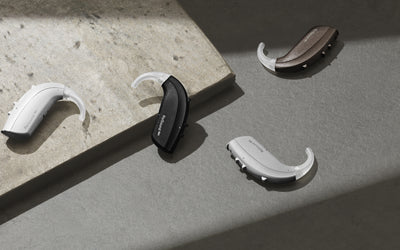
If a hearing aid is recommended, today's devices are a world away from the bulky, whistling devices of the past. Discreet RIC (Receiver-in-Canal) hearing aids from leading brands like Phonak, Signia, and ReSound sit almost invisibly behind the ear and deliver remarkably natural sound. Browse our top hearing aid picks to find the right match for your lifestyle and budget.
4. Tell the people around you
Let family members and colleagues know you are addressing your hearing. Simple adjustments, facing you when speaking, reducing background noise, make conversations significantly easier while you seek treatment or adjust to hearing aids.
5. Protect your hearing going forward
Noise-induced hearing loss is preventable. Use ear protection in loud environments, keep headphone volumes at a safe level, and give your ears time to recover after loud events. Good hearing habits now protect your hearing, and your brain, for the long term.
Ready to Take the Next Step?
Browse our full range of discreet, clinically proven hearing aids, available online at wholesale prices, with expert audiologist support included.
Frequently Asked Questions
Is it normal to ask people to repeat themselves all the time?
Occasional mishearing is normal. But if asking for repetition has become a daily habit, especially in quiet environments or one-to-one conversations, it is a significant warning sign of hearing loss and worth investigating with a hearing test.
Why do I struggle to hear in noisy places but seem fine elsewhere?
This is one of the hallmarks of early hearing loss. When background noise is present, your auditory system has to work much harder to separate speech from competing sounds. Early hearing loss impairs this filtering ability before it noticeably affects hearing in quieter settings.
Why do people with hearing loss think everyone is mumbling?
Hearing loss typically affects high-frequency consonant sounds first. Since consonants carry most of the meaning in speech, losing them makes words sound incomplete or blurred, like mumbling, even when the speaker is perfectly clear. It is the ears, not the speaker.
At what age does hearing loss typically begin?
Age-related hearing loss can begin as early as your 40s, though it becomes significantly more common from age 55. By age 70, the majority of adults have some measurable degree of hearing loss. That said, noise-induced hearing loss can affect people of any age.
Can hearing loss come back on its own?
Sensorineural hearing loss, the most common type, is generally permanent, as it involves damage to the inner ear's hair cells, which do not regenerate. Conductive hearing loss (caused by blockages or infections) can sometimes be temporary and treatable. Either way, a hearing test will clarify what you're dealing with.
What is the best hearing aid for someone with early hearing loss?
For early-to-moderate hearing loss, a discreet RIC (Receiver-in-Canal) hearing aid from brands like Phonak, Signia, or ReSound is typically recommended. These are small, comfortable, and highly effective. Browse our top hearing aid picks or contact our audiologist team for personalised advice.
Can hearing loss cause memory problems?
Untreated hearing loss is associated with faster cognitive decline and a significantly increased risk of dementia. The brain's constant effort to compensate for missing sound can deplete resources needed for memory and thinking. Read more in our guide on hearing loss and dementia.
Shop All Hearing Aids
Shop now
Shop Accessories
Shop now
Speak To Our Audiologists
Contact Us