

By
Karis Simms
Short answer: A Meta glasses hearing aid does not exist. Meta's Ray-Ban and Oakley glasses have a feature called Conversation Focus that boosts the voice of the person you are facing in noisy places, but the glasses are consumer smart glasses, not a hearing aid. They are not programmed to your hearing, they are not designed to treat hearing loss, and they do not come with audiologist support. A real hearing aid is built, fitted and adjusted for your specific hearing profile.
If you have seen the headlines about "meta glasses hearing aid" features and wondered whether a pair of stylish glasses could replace hearing aids, you are not alone. It is a fair question, and the honest answer is more useful than a simple yes or no. This guide explains what Meta's feature actually does, where it genuinely helps, and where a real hearing aid does a completely different job.
6 ft
Meta's recommended range for Conversation Focus
1 voice
Amplified: the person you are facing
360°
Speech clarity from Phonak Sphere hearing aids
What are "Meta glasses hearing aids"?
When people search for a Meta glasses hearing aid, they are usually referring to Conversation Focus, an accessibility feature on selected Ray-Ban Meta and Oakley Meta HSTN glasses. Meta announced it at its Connect event in 2025 and began rolling it out through an Early Access Program. According to Meta's release notes, the feature has since expanded to a wider list of countries that includes the UK.
The key point is what Meta does not claim. Conversation Focus is presented as a way to hear conversations more clearly in noisy environments. It is not marketed as a clinical hearing aid, and it is not personalised using an audiogram.
How Conversation Focus works
Conversation Focus uses the microphones built into the frames, beamforming technology and real-time processing to pick out the voice of the person in front of you. That voice is then amplified through the glasses' open-ear speakers, and Meta says it sounds slightly brighter so it stands out from background noise. You can adjust the level by swiping the right temple or through the app.
Because the speakers are open-ear, you still hear the room around you. That is a genuine advantage for awareness and comfort, but it also means the amplified voice is competing with the very noise you are trying to escape.
Meta's guidance says it works best when you are facing the speaker and they are within about six feet. Turn to talk to the person beside you, or try to follow a group, and the feature has far less to work with.
Meta glasses vs a real hearing aid: side by side
|
Feature |
Meta glasses (Conversation Focus) |
Real hearing aid |
|
Designed to treat hearing loss |
No. Consumer smart glasses |
Yes. A regulated medical device |
|
Personalised to your hearing |
No audiogram-based programming |
Yes. Programmed to your audiogram by an audiologist |
|
What is amplified |
The voice directly in front of you |
All the sounds you need, balanced across every pitch you struggle with |
|
Group conversations |
Limited. Works best facing one person |
Designed for groups, with speech picked up from around you |
|
AI noise reduction |
Directional voice boost |
Dedicated AI processing that separates speech from noise in real time |
|
Wear time |
Only when you are wearing the glasses |
All day, indoors and out, with no frames needed |
|
Aftercare |
Software updates and general support |
Fine tuning and ongoing support from qualified audiologists |
|
Usage limits |
Reports indicate monthly usage caps, with more hours behind a paid plan |
No usage caps |
|
Best for |
Occasional help with background noise |
Mild to profound hearing loss |
There is one more difference the table does not show: a hearing aid has no camera. Whatever else it picks up, it will not be filming your lunch.
Where Meta glasses fall short
They are not fitted to your hearing
Hearing loss is rarely the same across all pitches. Most people lose high-pitched sounds first, which is why speech loses clarity even when it is loud enough. A real hearing aid is programmed to boost the exact frequencies you struggle with. Simply making one voice louder does not do that.
They only help while the frames are on your face
Hearing aids work from the moment you put them in until you take them out. Glasses depend on you wearing them, and on the person you are talking to being in front of you and close by.
There are usage limits to be aware of
Reports indicate Meta has introduced a monthly allowance for Conversation Focus, with extra hours available through a paid subscription. Terms differ by region and change over time, so check Meta's current policy before relying on the feature for everyday listening.
There is no audiologist behind it
With a hearing aid, someone qualified adjusts your settings as your hearing changes and your preferences become clearer. That ongoing support is a large part of why people get good results. Smart glasses offer software updates, not personal fine tuning.
Who might use the glasses, and who needs a hearing aid
Meta glasses can make sense if you hear well most of the time, occasionally find loud restaurants tiring, and already wear smart glasses for other reasons. In that case, Conversation Focus is a helpful extra.
A real hearing aid is the right tool if you:
-
often ask people to repeat themselves
-
turn the TV up higher than others in the room
-
find group conversations hard to follow
-
feel tired after social events because listening takes so much effort
-
have been told you have hearing loss
If any of those sound familiar, a good first step is our free online hearing screening. It takes a few minutes and gives you an indication of where to go next, and our UK-qualified audiologists can talk you through the results. A hearing screening is not a diagnosis, but it helps you decide whether hearing aids are worth exploring. Unlike waiting for a high street appointment slot, you can do it from your sofa today.
What a real hearing aid does differently
The gap between a smart-glasses voice boost and a modern hearing aid is widest in noise, which is exactly where Meta's feature is aimed.
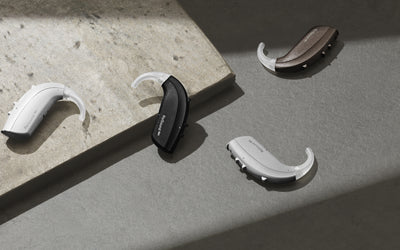
The Phonak Sphere range, for example, is built around a dedicated AI chip for separating speech from background noise. Rather than amplifying one voice in front of you, it processes the whole 360-degree sound environment in real time so you can follow speakers wherever they are. Our Phonak Audeo EON E90 Sphere is the newest model, with a smaller and lighter design, and the Phonak Audeo Infinio Sphere i90 introduced the technology. You can read our full Phonak Audeo EON e90-Sphere review for a deeper look.
Wholesale Hearing supplies these hearing aids with remote programming and aftercare from our UK-qualified audiologists, so you get professional support without the friction of travelling to a clinic and waiting for appointments. Browse the full Phonak hearing aid range and check live product pages for current prices. To see how remote care works, visit our hearing care page.
Frequently asked questions
Can Meta glasses be used as a hearing aid?
No. Meta glasses have a Conversation Focus feature that amplifies the voice of the person in front of you in noisy places, but they are consumer smart glasses, not a hearing aid. They are not programmed to your audiogram and are not designed to treat hearing loss.
Are Meta glasses better than hearing aids?
For hearing loss, no. A real hearing aid is programmed to your individual hearing profile, worn all day, and supported by an audiologist. Meta glasses give a general boost to the voice in front of you and suit mild difficulty in noise rather than diagnosed hearing loss.
Can I wear Meta glasses and hearing aids together?
Many people can wear both, but the results vary by frame, hearing aid style and personal comfort. Modern hearing aids such as the Phonak Sphere range already separate speech from noise on their own, so most wearers find the glasses' voice boost adds little.
How do I know if I need a hearing aid instead of glasses?
If you regularly ask people to repeat themselves, turn the TV up, or struggle in groups, take a free online hearing screening and speak to an audiologist. A screening gives you a first indication of your hearing, and a professional assessment confirms whether hearing aids would help.
Shop All Hearing Aids
Shop now
Shop Accessories
Shop now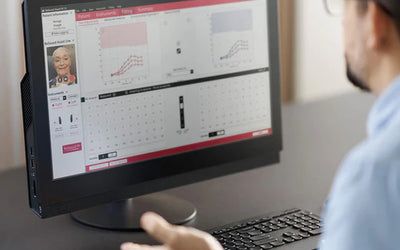
Speak To Our Audiologists
Contact Us